
Affordability and Abortion
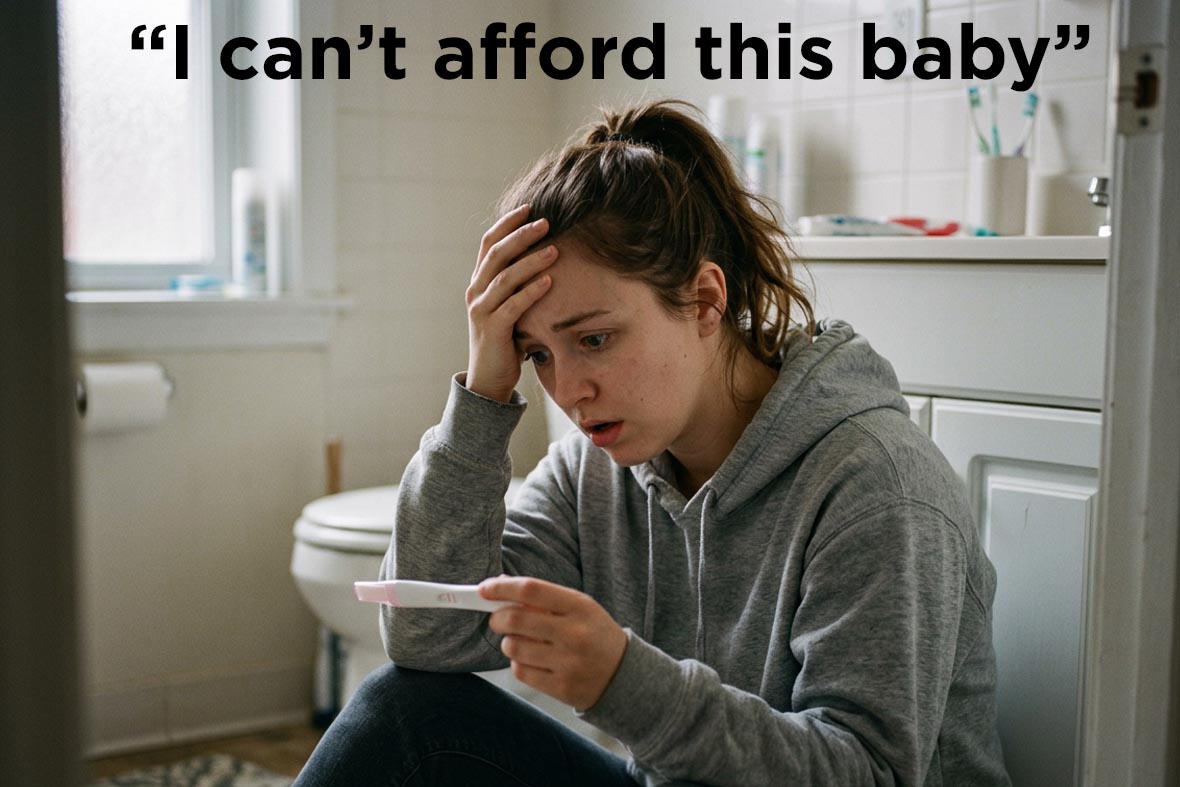
Economic concerns overwhelmingly outweigh other issues this political cycle. (Abortion as an issue doesn’t make the top ten.) And yet the economy has tremendous impact on abortion.
Pulse takes a closer look and sheds some honest light on these critical issues in a Q & A format:
Q. First of all, why do women have abortions?
A. Seventy-three percent of women interviewed by the pro-abortion Guttmacher Institute said they “could not afford a baby now.” That means, in this campaign cycle, that affordability and the economy are issues pro-lifers need to pay attention to.
Q. So what do the polls show?
A. According to a poll conducted by Pew Research in July, 29% of responders ranked the Net Economy as the issue they were most concerned about; followed by Cost of Living/Affordability at 15%; and the General Economy at 7%. Add them all up and you come up with 51% of registered voters ranked economic issues as their biggest concern in an open-ended question.
Q. Before continuing, is Pulse Life Advocates a partisan organization?
A. No. Pulse is a 501(c)(3)non-partisan, non-profit organization that promotes pro-life matters in the public and private square. We do not endorse candidates.
Q. Which party do voters think can do a better job on the economy?
A. According to Pew, it’s pretty evenly split, with Democrats ahead by a single point.
Q. So which party has actually done a better job with the economy?
A. The Wall Street Journal offered a concise recap last week. Since inflation is an ongoing concern of voters, they cited Consumer Price Index (CPI) data provided by the Bureau of Labor Statistics. It shows that the CPI increased an average of 5% a year during President Biden’s term compared to 2.9% for President Trump’s term so far (and only 1.9% per year for his first term).
Q. Why did housing prices under Biden’s presidency increase at twice the rate of Trump’s?
A. Housing prices increased 5.3% a year under Biden, compared to 2.7% for Trump’s first term (and 3.7% so far this term). According to the WSJ, “The Biden team also relaxed mortgage underwriting standards, which enabled borrowers to qualify for bigger mortgages and turbocharged the surge in home prices.”
Q. How were home prices in Iowa affected by economic policies over the past ten years?
A. They increased in Iowa about 2.7% during Trump’s first term; by about 4.2% during his second term, compared to 8.9% per year under the Biden presidency. Under Biden, prices skyrocketed by 12.54% alone in 2020 followed by 9.93% in 2022. Housing was more affordable under the Red party’s policies than the Blue Party’s.
Q. How about gasoline prices?
A. The inflation-adjusted price of a gallon of gasoline averaged $3.27 per gallon during Trump’s first term; $3.89 per gallon average during Biden’s term; and $3.43 per gallon during Trump’s second term. Even with the Iran War in progress, Red Party policies have kept oil prices below those of the Blue Party.
Q. How about grocery prices?
A. They also increased more under Blue Party policies than Red Party policies. Even with price spikes caused by the Covid pandemic, groceries, also known as “food at home,” increased by only 1.6% to 1.8% per year under Trump’s first term; under the Biden presidency, grocery prices increased by 5.58% per year; and in Trump’s second term, groceries have increased by 2.2% to 2.4% annually.
Q. Does either party propose other policy initiatives that could affect affordability?
A. Yes. Nationally, the Blue Party wants to more than double the minimum wage, from $7.25 nationally (which is Iowa’s minimum wage, too) to at least $15 per hour. Iowa Blue Party candidate for governor, Rob Sand proposes a 65% increase in the minimum wage at the state level. Red Party candidate Zach Lahn would maintain the current level.
Q. Is that good or bad?
A. It’s bad for low skill workers who are priced out of a job because of a higher wage mandate. It’s devastating to businesses which operate on thin profit margins like restaurants, grocery stores, and retail establishments. These businesses are forced to lay off employees to compensate for the higher wage government forces on them. It’s bad for consumers who pay higher prices, making affordability all the more difficult.
Q. How much impact does a minimum wage have on consumer prices?
A. According to the Employment Policies Institute, “minimum wage hikes will worsen the affordability crisis.” They write that decades of studies suggest that a “1$ wage increase can trigger overall price increases up to 5.5%, with fast-food prices spikes climbing much higher.”
Q. Are there any new policies on the horizon that will make education more affordable?
A. Yes. The One Big Beautiful Bill, passed in July of 2025, included a new federal Education Freedom Tax Credit. Beginning January 1st, 2027, it provides a dollar-for-dollar federal income tax credit of up to $1700 per individual ($3400 for married couples filing jointly) who make cash contributions to certified Scholarship Granting Organizations (SGOs).
Q. Are there any Iowa SGOs that will benefit from this tax credit?
A. Yes: Iowa Scholarship Granting Organization; Our Faith, Our Children Our future STO; Catholic Tuition Organization; Northwest Iowa Christian School Tuition Organization; North Central Iowa STO; School Tuition Organization of SE Iowa; Mississippi Valley School Tuition Organization; Iowa Lutheran School Tuition Organization Inc. to name a few. The infusion of cash into these programs in states that opt in will make education more affordable to families.
Q. Did this program receive bipartisan support?
A. No. Every member of the Blue Party in Congress voted against this tax credit. All members of the Red Party voted in support, except for two House members and three Senators.
Q. Have any states refused to opt in to this program?
A. Yes. According to the Wall Street Journal, 19 Blue state governors have refused to accept these funds which offer direct benefit to their constituencies. The only Blue State governors opting in so far are Colorado’s Governor Jared Polis who said his state would be giving up “free money” if he took a pass on it, and New York’s Kathy Hochul.
Q. How about at the Iowa level? Do any Blue Party Iowa candidates support Education Savings Accounts to make their kids’ education more affordable?
A. No.
Q. The One Big Beautiful Bill created federal income tax deductions for qualified tips and overtime through 2028, provisions that put more money into the pockets of working class Americans. Did any Blue Party Representatives and Senators support the bill?
A. As stated above, no.
***
Honorable voters can disagree on the merits and demerits of each piece of legislation presented at federal and state levels.
But when it comes to the issue of affordability/cost of living, the record makes a convincing case that the policies implemented by Red Party politicians have been more effective than those of the Blue Party at state and federal levels.
Again, Pulse focuses on issues as they relate to the pro-life cause. The number one reason women state for having abortions is their belief that they can’t afford to raise a child.
Affordability is a life or death issue for the unborn.
[Our Christmas Gala draws near! Passion of the Christ star, Jim Caviezel, is our keynote speaker. Get all the details right here.]
